

.jpeg)

TL;DR - Key Findings
Most B2B companies believe they have a demo automation problem. In reality, they are facing systemic GTM infrastructure failures.
In 100+ conversations with sales and GTM leaders, the same five breakdowns surfaced repeatedly:
- Demo data staleness
- Environment fragmentation
- Hidden engineering maintenance burden
- Setup time drag on sales velocity
- Integration and multi-user breakdowns
These failures are architectural, not tactical.
The cost is measurable: hundreds of engineering hours, thousands of sales hours, and lost credibility in high-stakes deals.
What is Demo Automation?
Demo automation is the practice of automating demo environment setup, refreshes, and configuration to reduce manual work before sales calls.
This works temporarily for simple products. It breaks down as products become integrated, multi-persona, and AI-driven.
What is GTM Infrastructure?
GTM infrastructure is the purpose-built system that enables repeatable, credible product demonstrations at scale, in real time, across scenarios.
It includes:
- Synthetic and time-relevant data generation
- Isolated, reproducible demo environments
- Multi-user and multi-persona orchestration
- Integration simulation or live connectivity
- AI-ready data structures
- Centralized ownership and governance
Demo automation improves workflow efficiency. GTM infrastructure determines whether your product can be demonstrated credibly at all.
Modern SaaS is time-sensitive, multi-user, deeply integrated, and increasingly AI-driven. Static demo environments fail fast under those conditions. AI features do not fail because the model is weak. They fail because the underlying GTM infrastructure lacks meaningful, structured, time-relevant data.
The Top 5 Demo Automation Failures B2B Teams Face
These failures are often blamed on weak demo automation. In reality, they stem from deeper infrastructure constraints.
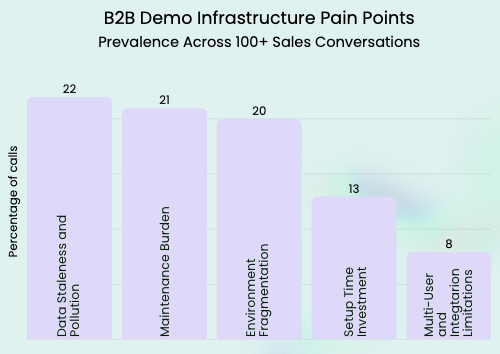
Our analysis revealed five recurring breakdowns, with demo data staleness emerging as the most prevalent issue across conversations.
Problem #1:
Why Demo Data Gets Stale (And How Fast It Happens)
Here's the dirty secret about demo environments: they have a shelf life measured in days, not months.
"After just one or two days, we’re already falling behind and the pressure builds from there." That's not one company. That's three different companies, describing the same problem to us.
The issue is simple: modern B2B products are built around time-sensitive workflows. Dashboards showing "this week's performance." Attribution windows. Aging reports. Open enrollment periods. When demo data is static, these features immediately expose the artifice.
Your sales engineer pulls up a dashboard in March showing "12 overdue items as of January 15th." Your financial platform displays transactions from 2022. Your HR system shows an open enrollment event from three years ago. Every outdated date is a small credibility hit.
But it's worse than staleness. Demo environments accumulate pollution. Every previous demo leaves artifacts. Every sales engineer who customizes a scenario, creates a test record, or demonstrates a workflow leaves traces that never get cleaned up.
"Our sales reps need to make changes to the demos, but these are saved and need to be dealt with by the next rep. It just creates cascading work that slowly wreaks havoc for us.”
Regular data refreshes should be the obvious solution, but they are much harder than they sound. Complex data models, integration dependencies, referential integrity. Multiple companies reported having engineering build refresh scripts that are slow, fragile, and require planning to execute. "Planning ahead sounds easy in theory, but it falls apart in reality. The velocity that some of the team is operating on makes it impossible. Then it’s too busy to be able to plan ahead for a day, and we can’t trust things that are running overnight. If it fails, we’re screwed."
One CEO's solution? "We’re trying to hire contractors in India to just try and make the data somewhat reasonable.”
That's not a solution. That's surrender.
Problem #2:
Demo Environment Fragmentation Across Sales Teams
Ask a B2B sales leader "What does your demo look like?" and watch them hesitate. Because there isn't one demo. There are many. Each with different data, different configurations, different stories, and wildly different quality levels.
As companies scale, demo environments proliferate like weeds. Individual AEs create their own sandboxes. Solutions engineers maintain separate environments for different verticals. Customer success has their own tenant. Product teams have staging environments that sometimes get borrowed for sales calls.
"It’s almost impossible to maintain a consistent story. In order to try, we have to leverage all sorts of different environments. But that in and of itself means our team needs to remember where stuff lives, they need to maintain all of these. We struggle to flow changes across, and then the story breaks again."
The bigger problem? Nobody owns it. Sales thinks product owns it. Product thinks engineering owns it. Engineering thinks sales owns it. The result: environments that drift without stewardship.
"Ownership doesn’t exist, I’ve got every team deflecting elsewhere. SEs blame the product team. Sales use something else. Product is frustrated by the SEs.”
When reps can't rely on demo environments to be in a known state, they develop defensive behaviors. They arrive early to check the environment. They avoid certain accounts because they don't trust what's in them. They stick to safe paths through the product instead of adapting to prospect needs.
Some companies try to solve this by consolidating to a single shared environment. This just creates different problems: "I’ve my entire Go-to-Market org in this one environment, and we’re just praying we don’t break it."
The shared environment becomes a tragedy of the commons. Everyone depends on it. Nobody wants to maintain it. Someone's changes will eventually break someone else's demo.
Here's what this really costs: you can't deliver consistent experiences across your sales team. Onboarding new reps takes longer because there's no single source of truth. Best practices can't propagate. The quality of your demos depends on individual initiative, not organizational capability.
What worked at 10 reps becomes chaos at 50.
Problem #3:
The Hidden Engineering Cost of Demo Maintenance
Here's the number that should terrify you: multiple companies reported dedicating 2+ full-time engineers to maintaining demo environments.
Not building product. Not fixing bugs. Not paying down technical debt. Maintaining infrastructure so sales can do demos.
"The expense of maintaining these demo experiences is a real burden. I’ve allocated two, well-paid, FTEs that I’ve had to carve off for it and I really wish I could use them elsewhere."
Demo environments require constant engineering attention. Production code needs to be propagated. New features need demo data. Integrations need configuration. Scripts need to run. Things break. Someone has to fix them.
For products with sophisticated configuration, creating a compelling demo isn't just data. It's painstaking, expert work. "Configuration changes alone are brutal. The best on my team? Still takes her over eight hours to do a customized demo that is right for our prospects."
Eight hours. For one demo. By your most experienced person.
Products evolve constantly. Demo environments need to keep pace. They rarely do. "It’s exhausting for us. The process is entirely manual trying to keep this thing up to date. We’ve got to stay on top of the current state of our application, not to mention new designs and features that are released. It’s hard, really hard."
So sales teams demo interfaces that don't match production. Features that exist in the product but not in the demo. They apologize. They explain. They work around it.
Some companies demo out of production to avoid this problem. That creates its own nightmare: "Every time we demo, I’m worried. I’m concerned that we’re going to show something we shouldn’t, but we’ve had to take these risks. I feel like I’ve no option but for us to demo out of our production Salesforce environment.”
When demo systems require dedicated engineering headcount, the issue is no longer sales enablement. It’s infrastructure debt.
Every engineer maintaining demo environments is an engineer not building product.
Problem #4:
How Much Time Does Demo Setup Really Take?
Before every demo, sales teams spend 20-30 minutes preparing. Checking that data looks right. Staging scenarios. Verifying integrations. Making sure the last demo didn't leave things broken.
Twenty minutes doesn't sound like much. But a sales team of 20, doing 5 demos per week, loses 33 hours per week. That’s a full FTE's worth of capacity, just on setup.
That's the best case. For complex products, setup is measured in days or weeks.
"A month, easily, and that’s when we are taking shortcuts. It’s honestly akin to an entire implementation which for us is four months. On one hand, it’s great to have an instance of our application that is specifically for demoing, but the amount of time that we sink into this…”
A month to set up a demo. This makes early-cycle demos impossible. By the time the demo is ready, prospects have already formed their opinions.
Even the fast setups create friction. Teams can't accommodate last-minute demo requests. Fast-moving opportunities hit artificial delays. The agility startups pride themselves on gets constrained by demo infrastructure.
And there's a temptation to over-customize. When setup is already time-consuming, why not go further and customize for the specific prospect? This creates exceptional experiences, but at a cost that doesn't scale. Your highest-performing reps become your least efficient, sinking hours into demo customization that should be spent selling.
In competitive deals, momentum wins.
Demo friction erodes it.
When reps spend hours preparing environments instead of advancing pipeline, deals stall.
Problem #5:
Why Integrations and Multi-User Workflows Break Demos
For products built around collaboration, two-sided interactions, or external integrations, the demo challenge isn't just data or maintenance, it's that the product fundamentally can't be demonstrated in isolation.
This breaks down into two distinct challenges:
The Integration Demo Problem
You can't show integration value without the integrated systems. Payment processors without credit cards. Telematics platforms without connected vehicles. Data pipelines without live data sources.
"SamSara would be number one. But it's not just them. We need to do it with more and more providers." explained a logistics software leader.
The workaround? Mock it out. Simulate it. Hope the prospect doesn't ask to see it live. "We end up just mocking up all of this vendor functionality that we need to show. It’s not like they have test or demo environments, so it’s on us.”
This becomes more acute as you move upmarket. Enterprise deals often hinge on specific integrations. When you can't show them working, you're selling on faith.
The Multi-User and Persona Challenge
Products built around collaboration face a different but equally thorny problem: you can't demonstrate collaborative workflows alone.
"We can’t escape it. As a project management tool it looks useless without being able to show all of these people working on things together. Otherwise, I’m trying to convince them with a blank screen."
The typical workaround is sales engineers frantically switching between browser profiles or having "two computers out. Our SEs in the background “reply” and hope no one notices."
But there's another dimension: showing the product from different user perspectives. Seller view vs. executive view. Admin vs. end user. Manager vs. individual contributor.
"We haven’t been able to solve it. What we really need is to be able to show a seller level and an executive level, that we can quickly toggle between during demos. Right now, we’re just stuck. We’ve to choose one because we can’t show both and it seeds doubt."
When you can't easily switch personas, you either pick one perspective and hope it resonates, or you awkwardly fumble through account switching mid-demo. Neither option is good.
This problem compounds with product complexity. The more sophisticated your permission models and role-based access controls, the harder it becomes to demonstrate them effectively.
The Path Forward: Building GTM Infrastructure Instead of Patching Demo Automation
GTM infrastructure has become a constraint on Go-to-Market execution. What worked at 10 reps and a simple product becomes an escalating burden as companies scale and products evolve.
The underlying issue is architectural. Most B2B companies treat demo environments as lightweight copies of production systems: copy the database, configure some settings, write some scripts. This creates a perpetual maintenance cycle where teams are constantly fighting to keep environments functional.
Demo environments have fundamentally different requirements than production:
- Time-relevance: Data needs to stay current without manual intervention
- Consistency: Every rep needs a known, reliable starting state
- Isolation: Changes can't persist between demos or pollute the environment
- Instant personalization: Adapt to prospect context in real-time, not over days
- Scale: Support dozens or hundreds of concurrent demo experiences
These requirements can't be bolted onto production infrastructure. They need purpose-built systems. They need demo infrastructure platforms that use synthetic data generation and automated environment management to solve these problems at the architectural level.
This is why we built TestBox. To treat demo infrastructure as a first-class platform, rather than a production afterthought. Companies using this approach report reclaiming 2+ FTE in engineering capacity, eliminating pre-demo setup time, and delivering consistent experiences across their entire sales organization.
The alternative is the status quo: teams spending increasing engineering time, operational overhead, and sales productivity maintaining infrastructure that performs poorly and gets worse over time.
That's not sustainable. And it's definitely not scalable.
Dealing with these demo infrastructure challenges?
Let’s talk about how TestBox approaches GTM infrastructure differently. We provide purpose-built systems. We generate synthetic data, automate environment orchestration, and eliminate the manual maintenance cycle.
FAQs on GTM Infrastructure
What is GTM infrastructure?
GTM infrastructure refers to the technical systems, environments, and data used to demonstrate B2B software products to prospects and customers. It includes demo environments, synthetic data, access controls, and the operational processes to maintain them.
What is the difference between demo automation and GTM infrastructure?
Demo automation focuses on automating setup and refresh tasks. GTM infrastructure is the underlying system that makes repeatable, credible demos possible across personas, integrations, and AI-driven workflows. Automation can reduce manual work, but without GTM infrastructure, demo environments still degrade, fragment, and fail in high-stakes deals.
Why is demo automation not enough for modern SaaS?
Modern SaaS products are time-sensitive, multi-user, integrated, and increasingly AI-driven. Automating data refreshes does not solve fragmentation, persona orchestration, integration reliability, or AI data readiness. Without purpose-built GTM infrastructure, demo environments degrade even if setup is automated.
When should a company invest in GTM infrastructure?
Companies typically need GTM infrastructure when demo preparation consumes engineering time, environments fragment across teams, AI features fail in demos, or setup time slows sales velocity. These are signals that demo automation scripts are no longer sufficient.
What are the signs your demo environment is failing?
Common signals include stale data within days, inconsistent experiences across reps, 20–30 minutes of prep before every demo, dedicated engineers maintaining demo systems, and difficulty showcasing integrations or multi-user workflows.
Why does demo data become stale so quickly?
Demo data becomes stale because modern B2B products are built around time-sensitive workflows (dashboards, attribution windows, aging reports). Unlike production environments, demo data is typically frozen at a point in time. Within days or weeks, date-dependent features expose outdated information, eroding credibility during sales presentations.
How much engineering time do companies spend on demo environments?
Based on our analysis, companies commonly dedicate 2+ full-time engineers to demo environment maintenance. For complex products, individual demo customizations can require 8+ hours of expert configuration time. Across a sales organization, setup and maintenance activities can consume 30+ hours per week.
What causes demo environment fragmentation?
Demo environment fragmentation occurs when individual sales reps, solutions engineers, and teams create their own separate demo instances without centralized coordination. This happens organically as companies scale, resulting in inconsistent demo experiences, no single source of truth, and an ownership vacuum where no team takes responsibility.
Why can't I demo integrations and multi-user workflows effectively?
Products built around collaboration, two-sided interactions, or external integrations can't be demonstrated in isolation. Integration partners often lack demo environments, forcing teams to mock functionality. Multi-user workflows require coordinating multiple accounts or awkwardly switching between personas mid-demo. These limitations make it nearly impossible to showcase the core value proposition of collaborative or integrated products.
How can I improve my demo environment?
The most effective approach is treating GTM infrastructure as a first-class platform with automated data refresh, centralized environment orchestration, and synthetic data generation. Companies using purpose-built demo infrastructure platforms report reclaiming multiple FTE capacity, eliminating setup time, and delivering consistent experiences across their sales teams.
What's the ROI of better demo infrastructure?
Better demo infrastructure delivers ROI through reduced engineering overhead (reclaiming 2+ FTE capacity), increased sales productivity (eliminating 20+ minute pre-demo setup), improved win rates (consistent, credible demos), and faster sales team onboarding. Companies report reclaiming hundreds of hours per quarter in engineering and sales time.


